
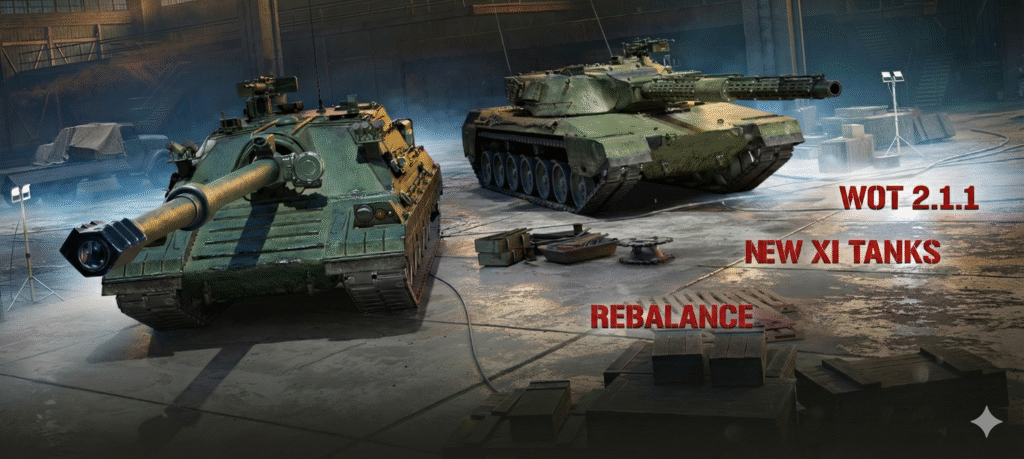
With the arrival of mid-January, the World of Tanks battlefield will shake under the tracks of new machinery. Update 2.1.1 brings not only two brand new Tier XI vehicles with unique mechanics, but also much-needed adjustments to existing “eleven” machines, which should return them back to the game. Let’s take a look at what awaits us.
Fresh steel is rolling out. Beyond adding two mechanically unique vehicles to the Chinese and Japanese lines, this patch finally addresses the balance issues plaguing the current Tier XI lineup.
Chinese Tank Destroyer
The first machine we’ll focus on is a direct successor to the WZ-113G FT line. At first glance, the PTZ-78 impresses with its sloped front armor and two thrusters on its hull. The PTZ-78 is the first tank destroyer in World of Tanks equipped with sequential rocket thrusters.
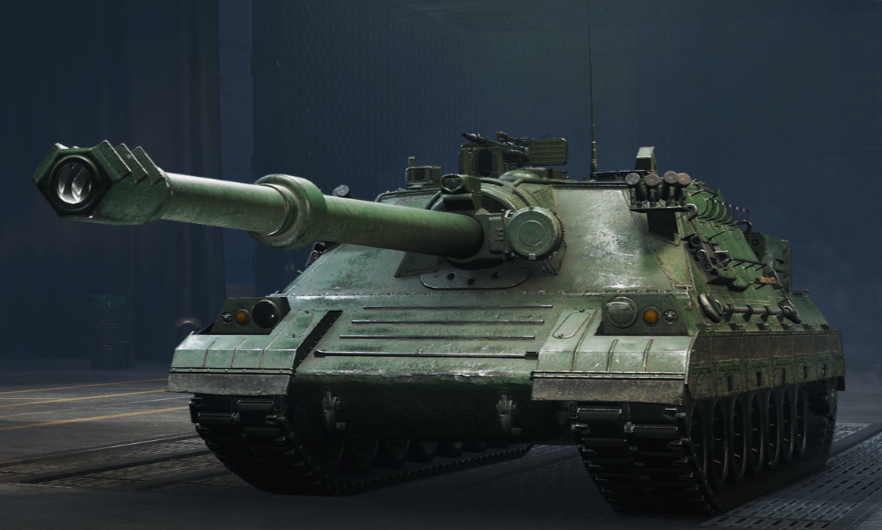
Compared to the established thruster system on existing tanks, however, it comes with a revolutionary change. Unlike the classic “boost”, where it is almost impossible to maneuver, the thrusters on the new Tier XI work independently of each other. You will have a total of 10 boosts of 10 seconds each available, increasing your already pleasant speed of 40 km/h to 45 km/h.
Besides simple acceleration, the thrusters allow for lightning-fast maneuvers, including a 180-degree turn. Simply put, as soon as you want to turn, one side of the thrusters turns off, and you turn faster to the selected side. This ability solves the biggest weakness of turretless tank destroyers – vulnerability when being flanked by light tanks. If someone tries to attack your rear, the PTZ-78 can immediately turn to face the threat.
But that’s not the only thing this tank offers; definitely don’t forget its firepower. The combination of 770 ALPHA (1150 with HE) with 300 mm penetration on basic ammo (400 mm on Gold) and pleasant gun handling, which is slightly better than its predecessor, makes this jet an unpleasant opponent, because with dispersion 0.35 at 100 m it won’t have a problem hitting you even at a distance.
When you have to fight up close, you have incredible 2300 HP and 130 mm of frontal sloped armor at your disposal.
Japanese Heavy Tank
The successor to the Type 71 line with a hydropneumatic chassis and Gun Cooling mechanic tries to revive a mechanic that is dead in my opinion and absolutely negligible compared to other Tier XI vehicle abilities. I won’t lie, I’m not a fan of gun cooling, because from my experience it doesn’t play any role in battle anyway.
Active gun cooling on the new Japanese heavy STK-2 works as a double-edged sword. If you let the gun “cool down”, the tank behaves like a precise sniper with low dispersion. Even so, it’s a step back compared to Tier X.
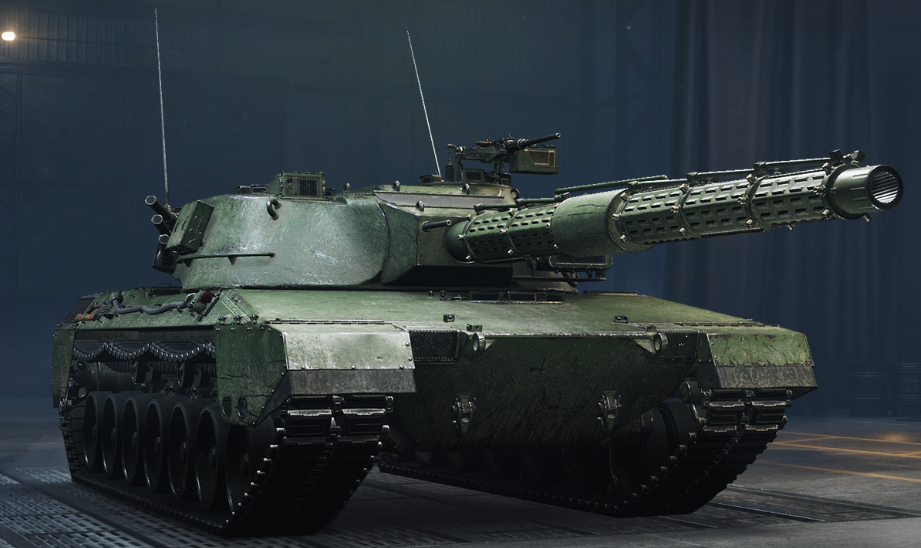
As soon as you start firing as fast as possible, the gun heats up and the aiming circle increases. You have to decide dynamically: “Should I shoot slowly and surely from a distance, or dump it into the opponent at ‘contact distance’ at the cost of lower accuracy?“
The way Wargaming presents it sounds great, of course, but the real impact in battle has so far been miserable on all machines with this mechanic. The STK-2 newly brings the threat of complete gun overheating, which will worsen your dispersion from 0.22 to 0.47 at 10 meters, but with a gun loading of 9.7 seconds and a little patience, you shouldn’t even approach this extreme. If you somehow do manage to overheat the gun, you will have to wait 32 seconds for it to cool down.
From the demonstration on the official website, it is evident that the gun cools down shortly after reloading. You should therefore deal 480 damage (620 with HE) with 270 mm penetration per shot without major problems. For greater penetration, you will have Gold available with 330 mm penetration.
This machine won’t impress with its survivability either. Frontal hull armor only 60 mm, 280 frontal turret armor and 2400 HP. It is definitely not a machine that I would necessarily need in my garage.
Big Rebalance
Update 2.1.1 responds to player feedback and server data. Six existing Tier XI vehicles will receive noticeable improvements to be able to compete on the battlefield. Let’s take a look at all the changes progressively.
If any machine really needed adjustment, it was the Strv 107-12. the Swedish specialist will now be more flexible. Switching between travel mode and pillbox mode will newly take only 5 seconds. Additionally, in pillbox mode, it reloads faster (newly -12.5%) and shoots more accurately (after update -25% dispersion at 100 m). Switching from siege to pillbox mode will also speed up to 3 seconds; back it will take only 2 seconds. If you have to leave a position, you switch from fortified mode to travel mode in 3 seconds. Definitely important changes in switching between modes with a pleasant bonus of improved firepower in fortified mode.
The second tank destroyer, Hirschkäfer, will no longer be so dependent on warming up. After the update, it will gain 600 Alpha per shot and will reload 0.2 s faster. Its dispersion during turret traverse will also improve to 0.27 at 100 meters.
The Soviet medium Object 432U received an injection in the form of 50 HP and reinforced frontal armor (fewer weakspots). Gun reloading will decrease to 11.5 s. The thermobalic overheating mechanic will also be more efficient. Newly, charging the first stage will take you one second, the second 2.5 seconds and the third 3.5 seconds; at the same time, the time before charge overheating will extend to 7 seconds. And if you don’t manage to shoot even during that time, the charge overheating duration will newly be only two seconds instead of four.
The Polish CS-67 Szakal will surprisingly be even more dangerous, as it gains better dispersion 0.33 at 100 m and higher DPM thanks to 8.6 s gun loading. Dispersion during movement and hull traverse will also improve from 0.12 to 0.10 and reverse speed to 17 km/h, which is key for “shoot and scoot” tactics.
The French autoloader AS-XX 40 t will be more reliable. With all upgrades, its dispersion after a shot will decrease to 2.5% as well as during turret rotation to 0.09, magazine reload will speed up to 33 seconds and its APCR shells will fly almost a third faster, 1,380 m/s.
The German sniper Leopard 120 will receive 50 more HP, better dispersion during movement and hull traverse 0.18 instead of 0.20 and overall higher dispersion 0.31 at 100 m. Its HEAT shells also significantly speeded up to 1,360 m/s, which will facilitate firing at moving targets. Even so, for me, these are surprisingly insufficient changes to this tank and I’d rather still play Tier X.
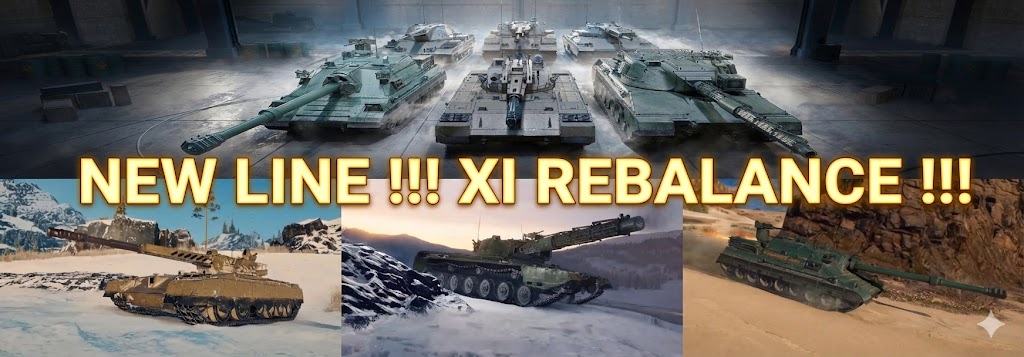
Update 2.1.1 arrives in the game as early as mid-January. Use the remaining time and remind yourself of the year 2025 in World of Tanks, or look at what new line update 2.1.1 will bring to the game!

Pingback: New Ares Line in WoT: No Need To Reload! - GameNebula
Pingback: WoT Update 2.1.1: How to Pene The New XI and New Bond Offers - GameNebula
Pingback: WoT Update 2.2.1: New Map, New Tier XI Tanks, and Much More! - GameNebula